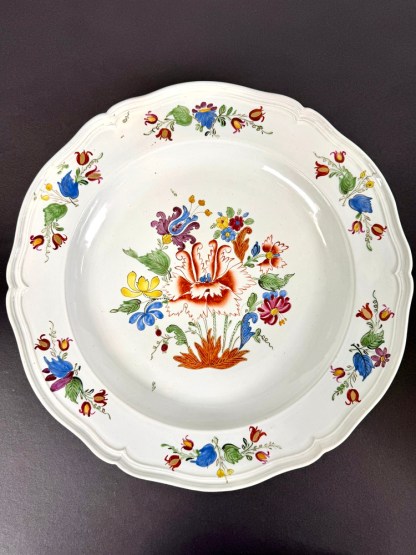
Antique Italian Porcelain Large Plate Hand-Painted Tulip Pattern, Doccia C-1760
$ 93.39
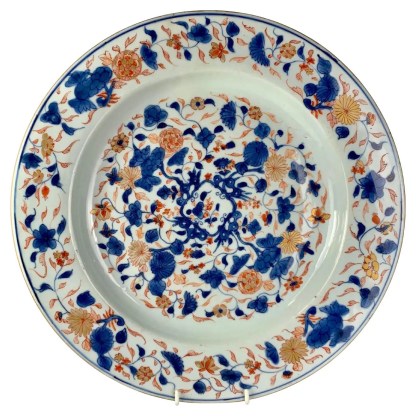
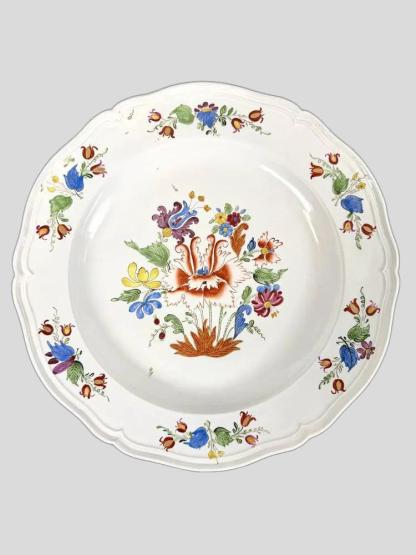
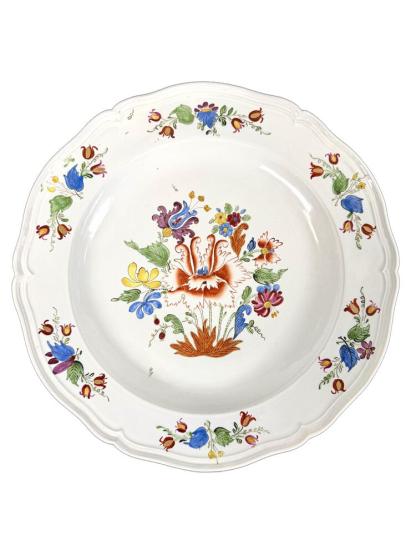
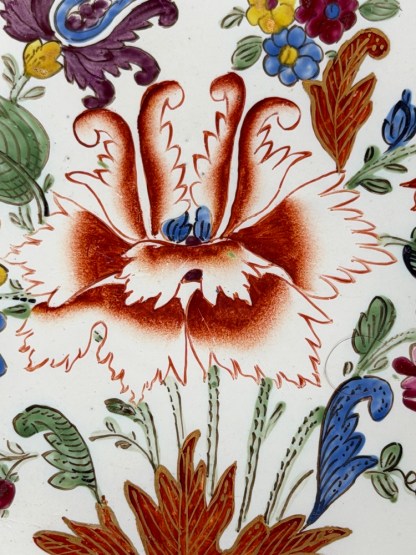
This antique Italian porcelain plate was made at the Ginori Doccia manufactory near Florence in the mid-eighteenth century and represents one of the factory’s most admired decorative patterns. Hand-painted circa 1760, in the celebrated porcellana antica modello Tulipano design, the composition centers on a boldly rendered tulip rising from an iron red base, surrounded by blue, yellow, green, and purple blossoms arranged with confident asymmetry. The palette is distinctly Florentine, warmer and softer than its German or French contemporaries, and set against Doccia’s characteristic milk white tin-glazed surface. The gently lobed rim, defined by a raised double outline, provides structure and restraint. Evenly spaced tulip sprigs decorate the border, creating rhythm and balance while keeping the central bouquet dominant. The scale at 13.25 inches gives the decoration room to breathe, reinforcing the plate’s decorative authority. Antique Italian porcelain from Doccia is particularly admired for its unusual use of tin glaze on hard-paste porcelain. This technical choice gives the surface depth and warmth and allows iron red to glow with particular richness. The Tulipano pattern was among the most favored designs produced at Doccia in the eighteenth century and appears on important documented forms in major museum collections. Dimensions: 13.25 inches diameter, 1.5 inches height Condition: Excellent Reference: Arthur Lane’s Italian Porcelain Plate 52A Decoration: Hand-painted tulip and floral decoration in the porcellana antica modello Tulipano pattern Material: Hard paste porcelain with tin-glazed surface Style: 18th-century Italian decorative porcelain Origin: Doccia, near Florence, Italy Date: Mid 18th century Notable Details: • Strong iron red anchoring the central tulip composition • Classic Doccia milk white tin glazed surface with warm tone • Gently lobed rim with raised double outline • Evenly spaced tulip sprigs forming a structured border • Pattern associated with documented eighteenth-century Doccia examples