

How to Prime Tabletop Miniatures, and why it’s important!
- Posted by stuartl in Bike Protection
- No Comments
Priming is the 1st step in your painting process, and an important one at that. Applying a base coat, usually a matt spray, over the bare material of your miniature gives all of your subsequent painting something to grip onto, prevents paint chipping or rubbing off, and allows you to use thinner coats, preserving detail.
From your first Warhammer army or skirmish game warband, to a display miniature or even board game pieces, priming is an incredibly important first step, forming the foundation for the rest of your paint scheme. Skipping this step will make painting extremely difficult, force you to fight with the paint to get it to adhere to the model, and result in flakey, weak paint that rubs off as you handle the miniature. Done well and then the rest of your paint scheme is easier, with your hard work much more likely to stand the test of time.
There are a few ways to prime your miniatures, getting them ready for your paint scheme, each one has their pros and cons, and finding the right one for you is usually a case of trying them all out.

Brush On Primer
Usually where most hobbyists start. Classic painting starter sets often came with those couple of miniatures, a brush, and a handful of paints, one of which was a thicker, black primer.
They are good for learning, showing new hobbyists the concept of priming, and the need for a good 1st layer to provide that paint adhesion.
The downside… We all painted them on too thickly, obscuring a ton of detail. And, it takes forever!
Airbrushing
At the far other end of the spectrum we have Airbrushing. For the hobbyist who is looking to push their skills and investment to the highest level.
Airbrushing can be great. It gives you a lot of pin-point control, allowing you to be accurate with your application. This can open up a lot of great, new techniques including OSL (Object Source Lighting), gradients, and more. And if you have the set up with ventilation and space, you can airbrush all year round, regardless of the weather.
The downsides are pretty big. There is a larger level of investment needed to get set up, requiring the airbrush itself, a compressor, and some form of ventilation. The use of an airbrush can also be tricky, learning the techniques, keeping the tools clean and un-clogged can be a whole hobby in itself. Plus there is storage, when hobby space is usually at a premium already. (As I write this I’m looking at my airbrush gathering dust on a shelf next to the 3D printer, and I’m realising that my hobby is mostly tinkering with things, sometimes it’s cool minis, sometimes machines to supplement the cool minis)
Rattle Can Spray Primers
The choice of primer for the vast majority of hobbyists. And with the variety available in today’s tabletop hobby, there is no longer a need to use primers that “sort of work” but are really made for car bumpers, or furniture.
Rattle cans provide fast, smooth, and even coverage across a model. Great for large batches of miniature, and purposefully designed to be an excellent surface for acrylic paint to adhere to. Affordable, quick and easy to use, with the only limitations being the need for a bit of outside space, and some nice weather.
What Colour Should You Pick?
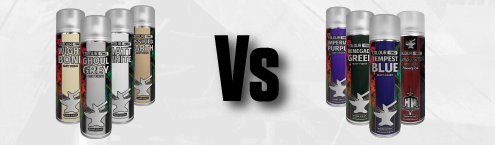
The vast majority of hobbyists stick with the older, more limited choice, of White or Black. White for lighter, or brighter colour scheme. Black for darker, more muted, or gritty colours schemes.
Here at The Colour Forge we’ve also brought a massive variety of colours to unlock a load of new techniques, and provide hobbyists with the ability to choose the perfect primer for every paint scheme.
The spray primer you choose will affect the final look of your models. In the same way the choice between White and Black primer changes the saturation, brightness, or look of a final paint scheme. Adding coloured primers into the mix will have a noticeable effect.
Not only will it change the final look of the scheme, but these colour options open up a wealth of painting techniques, hacks, and time savers. Here are a few examples:
Off White and Black: White and Black primers are great, and the easy choice, but when you’re painting white or black paint schemes, having the main colour be pure black or pure white can make models look flat, uninteresting, and unfinished. With pure white you aren’t able to add highlights, and with pure black you can’t add recess shading, steps that really make models pop. Using an “almost” black and adding a wash, or using an “almost” white and adding a pure white highlight, give the illusion of those pure colours whilst also bringing depth and interest to the model.
Zenithals: Priming a darker colour from below and a lighter colour from above (sometimes with a midtone to soften the gradient) helps create a natural light look, working especially well with contrast/speed paints. Reverse this technique to give a ghostly/otherworldly underlit effect.
Purple Primer: Perfect undertone for many fantasy and sci-fi skin colours. Drybrushing or sponging over the top of purple can create real depth to a skin tone bringing a model to life (or Un-life in the case of zombies). This works particularly well for Orcs with green over the top, as well as anything ghastly or undead with pale colours to give that rotten look.
Yellow and Pink: Yellow is notoriously difficult to paint… unless you use the correct primer. Yellow primer for a yellow scheme makes sense and works well. Pink primer also works extremely well, adding more warmth to the yellow and can help deepen recess shadows giving a model more depth.
Gold and Brown: What is true for painting yellow, is true for painting Gold. Again, we give you options to find the right solution for you. Prime gold for that great coverage and consistent finish, or try priming in a brown with Gold drybrushing or sponging to build up layers and depth.
Browns: It’s obvious how useful different colour browns are, we have an absolute bucket load of these colours. Great for terrain and basing allowing for washes and drybrushes to help show off detail without having to spend an age painting in all those recesses and around all that detail.
Greens: Like Brown, we hold a load of green shades making the choice of primer easier to get right. From sea blue-green colours, to light and dark camouflage tones, through to bright saturated greens for armoured space giants.
We have a load of handy guides in our tutorial library for how to use spray primers, Slapchop in a can, painting big armies and big terrain sets easily, plus a load more.
Check them out and grab a free guide.