English Salt Glazed Stoneware Teapot with Pink Enamel Decoration, circa 1760
$ 93.26
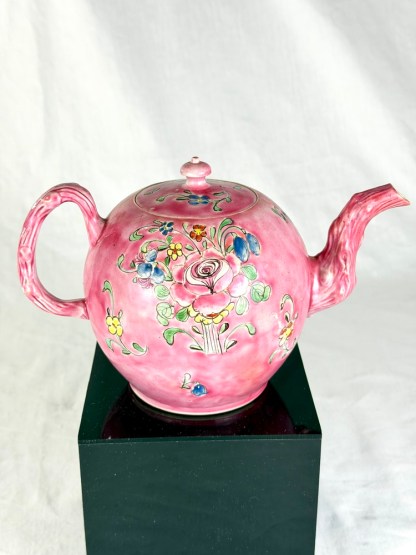
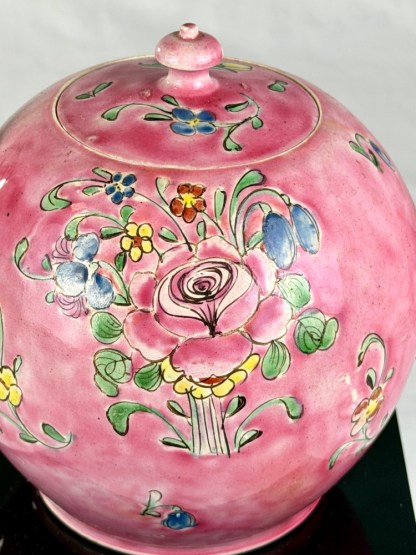
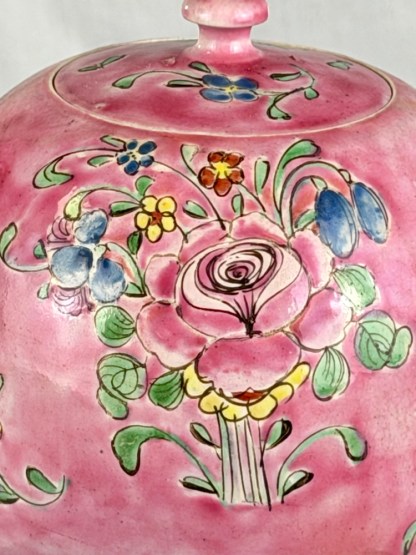
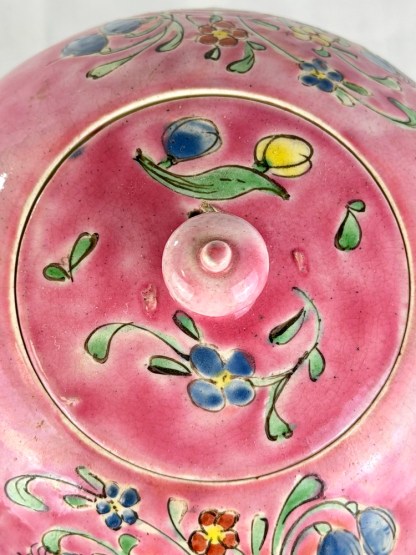
This English salt-glazed stoneware teapot belongs to a small and fascinating group of mid-18th-century wares that combine the robust body of Staffordshire salt glaze with delicate overglaze enamel decoration. Dating to about 1760, it reflects a moment when English potters were experimenting boldly with color and surface while responding to the fashionable influence of Chinese export porcelain. The form is confidently modeled. The rounded globular body sits firmly on a small foot, while the branch-shaped spout and handle introduce a lively sculptural quality. The domed cover with its small knop completes the composition with pleasing proportion. These molded branch elements are a distinctive feature of the period and add both visual movement and a naturalistic charm. The surface is washed in a rich pink ground, over which hand-painted enamel flowers unfold in soft greens, yellows, and blues. The drawing has a relaxed softness typical of enamel work on salt-glazed stoneware. The palette harmonizes beautifully with the warm pink ground. Salt-glazed stoneware represented England’s first internationally successful ceramic industry. The process produced a hard, dense body with a subtly textured surface, created by introducing salt into the kiln during firing. Adding enamel decoration required a second, lower-temperature firing, increasing both cost and production risk. For this reason, enamel-decorated examples such as this are considerably scarcer than undecorated salt-glazed teapots. Closely related examples are held in major museum collections. An almost identical teapot is preserved at the Nelson-Atkins Museum of Art and was illustrated in the 1966 exhibition Cathay Invoked: Chinoiserie, A Celestial Empire in the West. Pieces of this type are generally associated with Staffordshire production, often linked to the Whieldon circle or related workshops. However, exact attribution remains uncertain, and they are traditionally catalogued simply as English. This teapot captures an important moment in English ceramic history when potters were exploring new decorative possibilities while adapting international influences to their own materials and techniques. The lively branch modeling, the rare pink enamel ground, and the floral painting together create a piece of unusual charm and presence. This teapot is a remarkable piece for its elegance and finesse of execution. Dimensions: 8.5″ from spout to end of handle x 5.5″ tall x 5″ diameter at the widest point Condition: Excellent with a small (1/4″) flat chip invisibly restored on the underside of the tip of the spout Decoration: Overglaze enamel floral decoration on pink ground Material: Salt-glazed stoneware Style: Mid-18th-century English Chinoiserie Origin: England Date: Circa 1760 Notable Details: Rare combination of salt-glazed stoneware with overglaze enamel decoration Rich pink ground with hand-painted chinoiserie floral motifs Sculptural branch-shaped spout and handle characteristic of the period A closely related example in the Nelson-Atkins Museum of Art Survives in excellent condition with only a small restored spout tip chip